- Product

- Pricing
- Affiliate Program
- Developers
- Resource
 EN
EN
MoreLogin was easy to describe a few years ago. It was an antidetect browser for keeping browser profiles separate. That label now misses much of the product.
In 2026, MoreLogin is better understood as a workspace for web and mobile account operations. Browser profiles handle websites. Cloud Android Phones handle mobile apps. Automation reduces repeated work, while team permissions decide who can use each environment and what they can access.
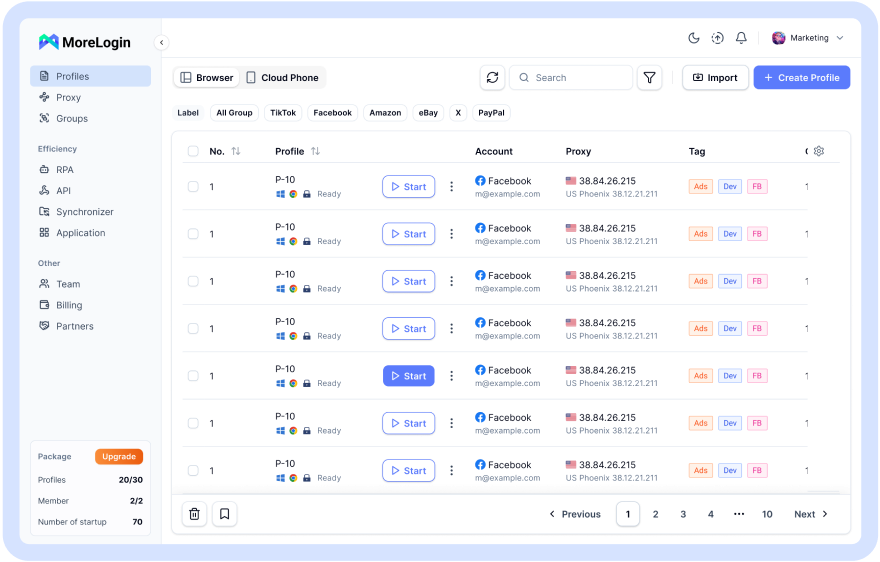
MoreLogin makes the most sense for teams that manage accounts across both websites and Android apps. Its main strength is not one feature in isolation. It is the way three parts work together:
Each account gets a dedicated browser or Android environment.
Repeated work can move from manual operation to Synchronizer, RPA, APIs, or AI Agents.
Managers can assign access without handing every employee full control of passwords and account assets.
It fits agencies, ecommerce teams, social media operations, and technical teams with repeatable account workflows.
It is harder to justify for one person managing one or two normal logins. A standard browser profile may already cover that job.
MoreLogin gives each account a place to run and keeps that environment available for later use.
For a web account, that place is a browser profile. It can retain cookies, storage, login state, proxy settings, extensions, and fingerprint settings. The operator can reopen the profile and continue from the same session.
For a mobile account, the environment is a Cloud Android Phone. Apps, app data, files, device settings, and login state remain on the assigned cloud device.
Persistence is the key difference. Private browsing can separate a short session, but it is inconvenient for work that continues every day. MoreLogin environments can be named, grouped, assigned, reopened, and automated.
A team no longer has to ask which employee has the password or which laptop holds the session. It can see which environment owns the account and who is allowed to open it.
MoreLogin splits account work into two environment types.
Browser Environments for web accounts
Cloud Android Phones for mobile apps
Whether you need a browser environment does not depend on the number of accounts you manage. Even with just one account, MoreLogin can be useful if you need an isolated environment to preserve login sessions, configure proxies and browser parameters, or allow multiple team members to manage and hand over the account with different permission levels.
MoreLogin provides comprehensive browser environment management. Teams can create and group environments, assign them to specific members, configure proxies, and manage browser parameters such as User Agent, Canvas, WebGL, fonts, language, time zone, and WebRTC. These settings can remain saved within each environment, so there is no need to repeat the basic setup every time the account is accessed again.
For team collaboration, browser environments can also remain within a shared workspace instead of depending on the browser setup of a single employee’s computer. For example, if an e-commerce store is managed by different team members in shifts, or an external contractor leaves after completing a project, administrators can adjust environment permissions so another member can continue using the same environment while retaining its cookies, login state, and related settings.
When a business manages multiple accounts, separate environments can also be created based on its isolation requirements. Cookies, extensions, login states, proxies, and browser configurations can be kept within their respective environments, helping reduce configuration mix-ups and operational mistakes between accounts.
Browser environments are therefore not only useful for managing multiple accounts. More importantly, they provide relatively isolated operating environments together with clearer team permissions and collaboration workflows. Environment isolation can reduce unnecessary mixing of account data and settings, but it does not determine account status on its own. Factors such as account history, proxy quality, content, and actual operating practices still need to be managed separately.
A browser profile cannot cover a workflow that must happen inside an Android app.
Cloud Android Phones provide persistent Android environments on cloud based ARM infrastructure. Teams can install apps, upload files, retain login state, configure network access, and return to the same device remotely.
Cloud Phone earns its place when the app itself matters. Common examples include mobile social media, mobile ecommerce, affiliate workflows, app testing, and Android specific verification steps.
The strongest argument for Cloud Phone is not that it looks more modern than a physical phone. It removes the hardware handoff.
With physical devices, someone must buy, charge, label, store, repair, and ship them. Access becomes difficult when the team is remote. A cloud device can be assigned from the same workspace as a browser profile.
That does not mean every account needs a Cloud Phone. If the full job works well on the web, a browser profile is simpler and often cheaper. Cloud Phone earns its place when the Android app, mobile interface, device state, or mobile automation is part of the workflow.
MoreLogin offers several forms of automation. They solve different problems. Using the most advanced option first is usually a mistake. Pick the least complex method that can complete the task reliably.
Synchronizer is the easiest place to start because the operator remains in control.
In browser profiles, Synchronizer can copy supported mouse and keyboard actions from one main Chrome profile to other profiles. It also supports bulk text input, tab control, popup handling, and click delay.
Cloud Phone has its own multi device Synchronizer. It can open and install apps across selected phones. Batch operations, text input, and file uploads are currently limited to Model X.
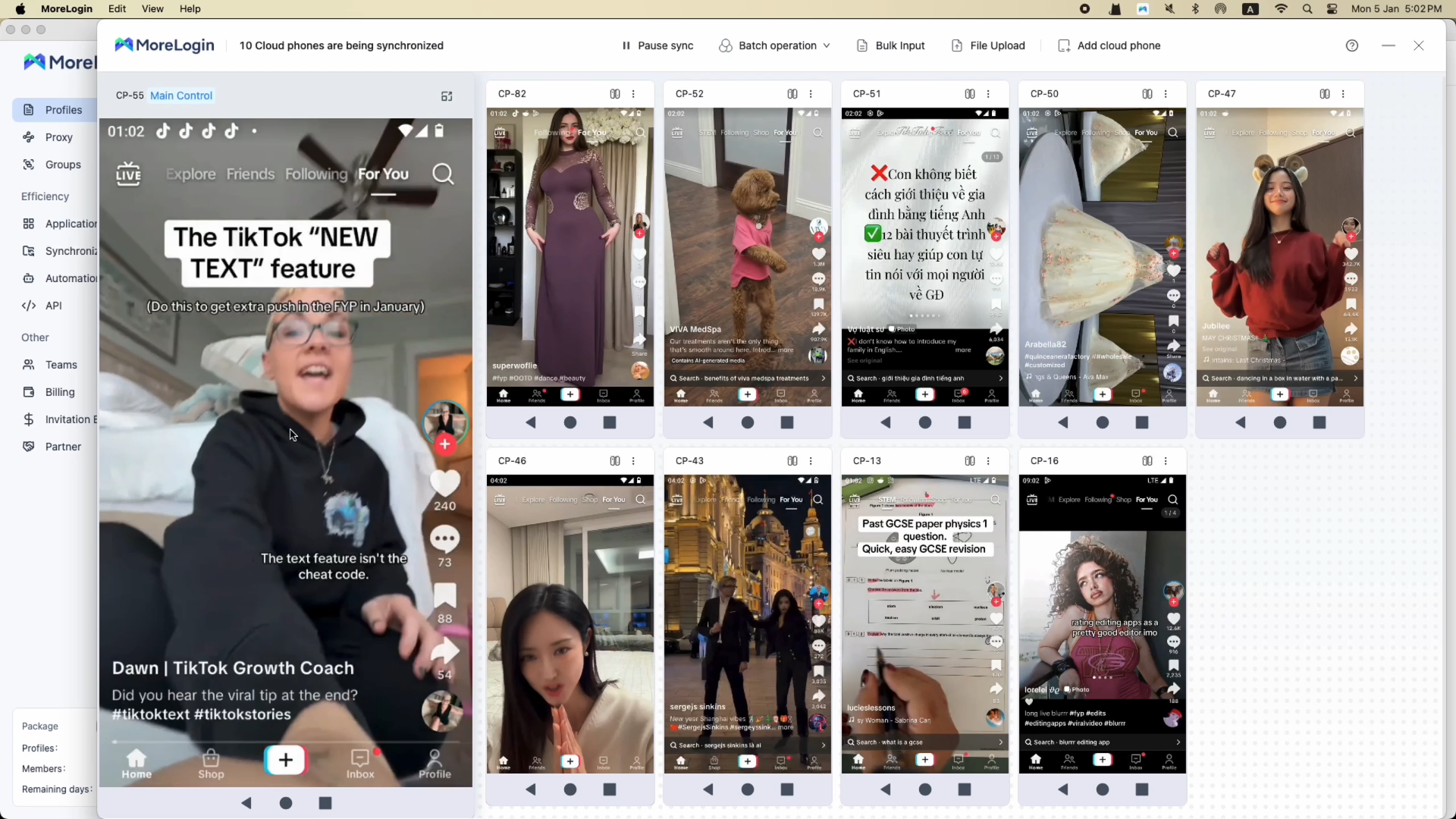
Synchronization works when the screens are in the same state. It breaks down when every account shows a different popup, language, verification request, or page layout.
Mirroring an incorrect click across twenty environments only spreads the mistake faster. Start with a small group, check that each screen matches, and keep the operator present.
RPA is a better fit when the steps are already known.
MoreLogin's Cloud Phone RPA supports configured actions such as clicks, swipes, text input, waits, conditions, loops, and data handling. Tasks can also be scheduled.
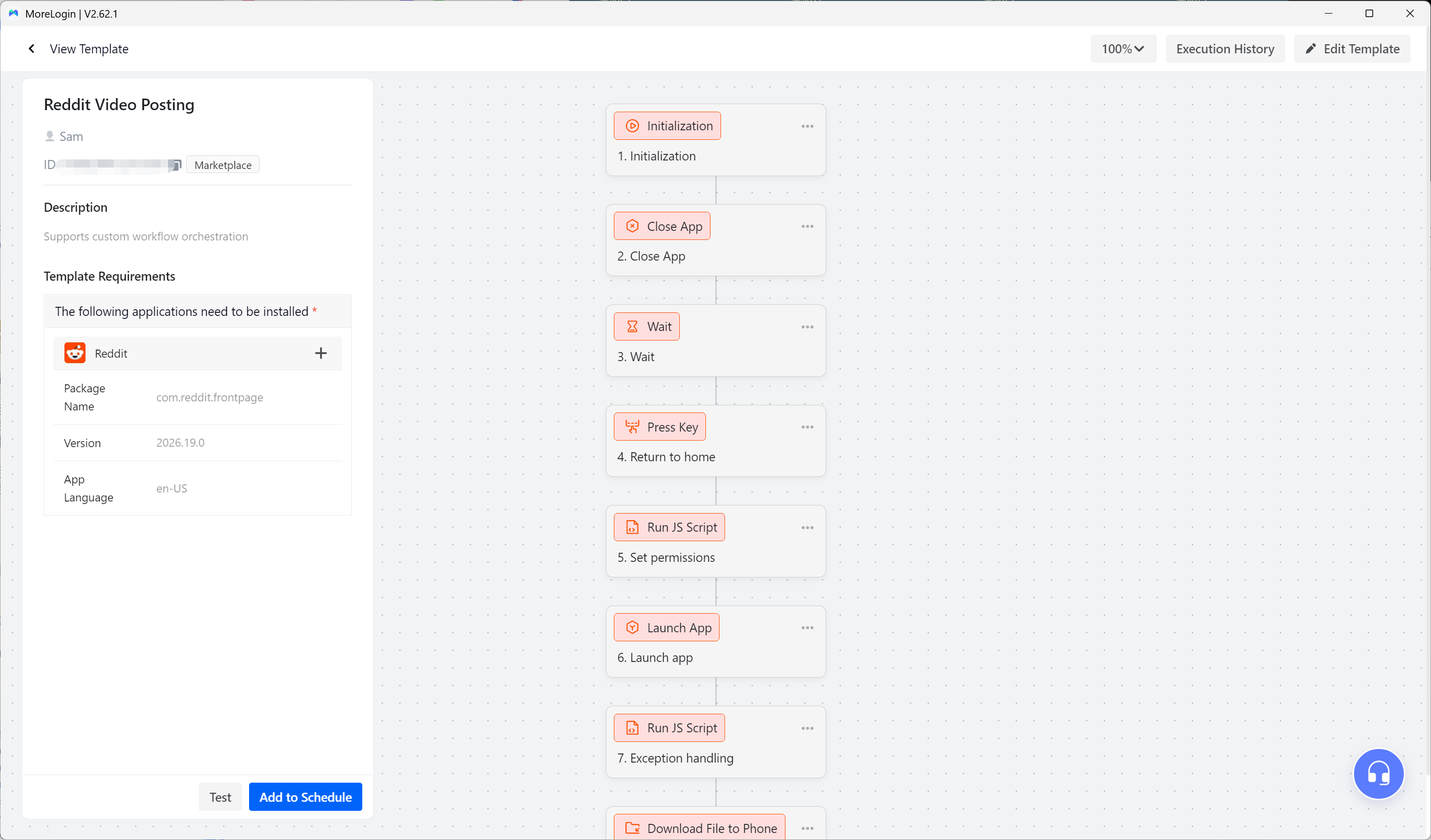
A good RPA task is predictable. For example:
Start the assigned Cloud Phone.
Open a specific app.
Navigate to a known page.
Enter prepared data.
Upload the assigned file.
Record the outcome.
The workflow should first be completed manually on one device. That exposes missing steps and common exceptions. Once the process is stable, it can be tested as an RPA flow and then expanded.
RPA is less suitable when page layouts change often or important decisions depend on context. In those cases, the flow needs more checks or a human handoff.
The same process can later combine Synchronizer, RPA, and AI within a broader Cloud Phone automation plan.
MoreLogin's developer tools connect account environments with scripts and internal systems.
The Local API runs through a computer with the MoreLogin client. Open API access supports remote Cloud Phone workflows. Available controls cover browser profiles, Cloud Phones, proxies, files, applications, groups, schedules, and other resources.
Common uses include:
Creating and organizing browser profiles
Starting or stopping browser and Cloud Phone environments
Installing apps and transferring files
Launching tasks from an internal dashboard
Connecting profile sessions to Selenium WebDriver or Playwright
Passing approved tools to an AI system through the Model Context Protocol
The developer layer is valuable when MoreLogin is part of a larger process. A CRM change, form submission, content approval, or task queue can trigger the next step without an employee moving data between systems.
Authentication data needs careful handling. Playwright's own guidance notes that saved browser state may contain cookies and headers that can be used to impersonate an account. Treat exported session data like a credential, even when the automation is internal.
RPA follows a path. An AI Agent works toward an outcome.
MoreLogin includes Commander for built in agent tasks, along with CLI and MCP connections for compatible tools. An agent can work inside the environments available to the current MoreLogin account and role.
Goal based execution helps when the result is clear but the exact screen path may vary. An agent could check selected accounts for expired sessions, collect status information, prepare an upload, or stop when a manual verification step appears.
The instruction should name:
The target environment
The website or app
The input data or file
The expected result
The actions that require approval
The point where the agent must stop
AI Agents should not receive broad access simply because the task is convenient. Payments, publishing, deletion, security changes, and other high impact actions need an explicit review point.
Multi account work becomes a management problem as soon as a second person joins.
The quick solution is often a password in chat or a spreadsheet of credentials. That saves a few minutes during setup and creates a much larger problem later. The company loses track of who can open an account, where the active session lives, and how access will be removed.
MoreLogin treats the environment as the unit of collaboration. A manager assigns a browser profile or Cloud Phone instead of transferring the whole account setup.
Team management includes Super Administrator, Administrator, Manager, and Member roles. Feature permissions and data permissions determine what each role can see or change.
Access can be granted to all environments, a group, or selected profiles. This supports practical divisions of work:
A content operator can open assigned social accounts without managing billing.
An ecommerce employee can work in selected stores without transferring profiles.
A manager can organize work without receiving every administrator permission.
A contractor can access one client group and lose that access when the project ends.
The model is close to role based access control, where permissions follow the job. Access should not expand simply because a person belongs to the team.
The role names matter less than the permission design. Before inviting members, decide who may open, edit, transfer, delete, or automate each environment.
MoreLogin can prevent selected roles from viewing saved passwords. Administrators can also restrict developer tools and apply stronger controls against scripts or extensions reading saved credentials on supported browser versions.
Cookies and active sessions remain inside the assigned environment. Team members can continue the work without copying those sessions into personal browsers.
An active session deserves protection similar to a password. OWASP session management guidance treats session handling as a link between authentication and authorization. Keeping sessions inside assigned environments reduces direct exposure and gives the company a clear place to control access.
Other account security controls include two factor authentication, login IP controls, optional profile encryption, extension data protection, URL restrictions, and sensitive page element controls.
Opening an account does not mean an employee should reach every page inside it.
Administrators can block selected URLs for defined members, roles, or profiles. They can also hide specified page elements such as phone numbers, email addresses, QR codes, or keys.
An operator can keep working without gaining access to billing, withdrawals, security settings, or credential pages.
Web element controls hide configured elements. They are not a universal system for blocking every possible button on every website.
Permissions help before work starts. Logs help when a manager needs to understand what changed.
The operation log records management events such as logins, environment starts and stops, profile changes, Cloud Phone actions, and proxy operations. Records can include the operator, IP address, location, time, and result.
It is not a recording of every click inside a third party website. Its value is administrative traceability.
When an employee leaves or a contract ends, the manager can disable the member or remove access to the assigned environments. The browser profiles and Cloud Phones remain in the company workspace.
That is a cleaner handoff than changing passwords across every account and hoping no session was copied elsewhere.
The three parts work best in this order.
A company creates a browser profile or Cloud Phone for an account.
A manager assigns that environment to the person responsible for the work.
The operator completes the process manually and documents the stable steps.
Repeated actions move to Synchronizer, RPA, an API workflow, or an AI Agent.
Sensitive actions keep an approval step.
Managers review access and operation logs when the project or team changes.
Each part solves a different problem. The environment keeps account data together. Automation saves time. Permissions keep that efficiency from turning into uncontrolled access.
Skipping that order creates predictable problems. Automation on unstable environments fails. Shared environments without permissions expose too much. Detailed permissions around a poorly defined workflow only add administration.
The sequence matters. Set up the environment first, assign access second, and automate only after the manual process works.
Agencies often inherit accounts, sessions, files, and access rules from several clients. A dedicated environment keeps each client separate. Profile assignment lets an operator work without making that employee the permanent owner of the session.
Staff changes show the value of that setup. The agency can revoke access and give the same environment to another approved operator.
Each store can have its own browser or Android environment, proxy settings, files, login state, and assigned team members.
The team can separate daily store work from higher risk areas such as payments, security settings, or account transfer. Browser profiles are usually enough for seller dashboards. Cloud Phones make sense when the marketplace app or mobile verification is part of the process.
Social media work often moves between web dashboards and mobile apps. Browser profiles cover the web side. Cloud Android Phones cover mobile first features and app specific tasks.
Synchronizer can speed up supervised setup. RPA can handle stable mobile routines. AI Agents can help with checks that do not follow the same screen path every time. Publishing and other public actions should keep a human approval point when the business impact is high.
Developers can connect MoreLogin with internal dashboards, task queues, content systems, and approval workflows.
The product adds the most value when automation needs persistent account sessions, Android devices, team assignment, or access controls. For public pages and ordinary browser testing, a general browser automation framework may already be enough.
The MoreLogin pricing page currently lists a free plan with two permanent browser profiles. New users also receive 100 Cloud Phone minutes.
That is enough to test the basic operating model:
Create separate browser profiles
Add a proxy and review environment settings
Check whether sessions remain available
Test profile organization and team access
Try a small synchronized workflow
Use the Cloud Phone allowance to test one mobile task
Paid browser plans scale by profile and team requirements. Cloud Phone uses a separate time based or monthly model.
Prices, promotional discounts, free allowances, and supported device models can change. Check the live page before purchase or publication.
MoreLogin still has limits.
No browser profile, proxy, fingerprint configuration, Cloud Phone, or automation tool can guarantee that a third party platform will never request verification or restrict an account.
Platform rules, account history, content, network quality, payment data, verification state, and operating behavior still apply. MoreLogin helps control the environment. It does not override the platform.
A clean profile does not repair a poor proxy. An unstable route or a mismatch between proxy location, timezone, language, and normal account activity can create problems.
Teams still need a clear network policy and a way to test proxy quality.
Websites and apps change. Buttons move, sessions expire, and unexpected verification pages appear.
Synchronizer needs supervision. RPA needs stable steps and exception handling. APIs need development support. AI Agents need narrow permissions and clear stopping points.
Automation reduces repeated work. It does not remove responsibility for the result.
MoreLogin is worth considering when:
You manage several web or mobile accounts.
Accounts must stay separated by client, store, project, or market.
Employees or contractors need access without receiving full credentials.
The same browser or Android work repeats across many accounts.
You need persistent sessions that can be reassigned.
Developers or AI tools need controlled access to account environments.
You want browser profiles, Cloud Android Phones, automation, and permissions in one workspace.
Start with the accounts, not the feature list.
List the accounts or projects that need their own environment.
Decide whether each job belongs in a browser profile or Cloud Android Phone.
Configure the proxy, browser, or Android settings required by the account.
Sign in and confirm that the environment keeps the expected session and data.
Organize environments by client, store, market, or team.
Assign the minimum access each member needs.
Complete the process manually before automating it.
Test automation on one environment and review the result before expanding.
Following that order prevents a common failure. Teams often automate a process before they have agreed on how the process should work.
MoreLogin's strongest value in 2026 is operational control across web and mobile accounts.
Browser profiles give web accounts a persistent home. Cloud Android Phones extend the same idea to apps. Automation handles repeated work at several levels, from supervised synchronization to APIs and AI Agents. Team permissions let managers decide who can use each environment and what they can reach.
The product is most useful when account work has moved beyond one person and one browser. It is less compelling when the need is only simple account switching.
Start with one environment and one real workflow. Set permissions before scaling the team. Automate the stable steps and keep a person responsible for exceptions.
MoreLogin gives teams a way to increase output without losing control of the accounts, sessions, and devices behind the work.
Is MoreLogin free?
MoreLogin currently provides two permanent browser profiles. New users also receive 100 Cloud Phone minutes. Paid plans add more capacity. Check the live pricing page because allowances and promotions can change.
Is MoreLogin only an antidetect browser?
No. Browser profiles remain a core part of the product, but MoreLogin also includes Cloud Android Phones, automation tools, AI Agent access, team permissions, and account protection controls.
What is the difference between a browser profile and a Cloud Phone?
A browser profile is built for websites. It keeps browser cookies, storage, login state, proxy settings, extensions, and fingerprint settings together. A Cloud Phone is a complete Android environment for apps and device level workflows.
Can teams use MoreLogin without sharing passwords?
Administrators can assign environments to team members and use role permissions, password protection, session controls, and access restrictions to reduce direct exposure of credentials. Teams should still test the selected controls before using them with sensitive accounts.
What automation tools does MoreLogin support?
MoreLogin supports Synchronizer, Cloud Phone RPA, Local API, Open API, CLI, MCP, browser automation frameworks, ADB workflows, Commander, and compatible AI Agent integrations. The right choice depends on whether the task is supervised, rule based, developer controlled, or goal based.
Can MoreLogin prevent account bans?
No tool can guarantee that. MoreLogin helps teams keep account environments separated and consistent. Platform policies, account history, proxy quality, content, verification state, and operating behavior still affect the account.
 EN
EN