- Product

- Pricing
- Affiliate Program
- Developers
- Resource
 EN
EN
Facebook is still one of the richest public data sources on the web: millions of active ads, brand pages, public posts, comments, groups and Marketplace listings. Marketers use it to reverse-engineer competitor funnels, agencies use it to report on client markets, and researchers use it to track political and commercial messaging.
The hard part is not deciding what to collect. It is collecting it reliably. Meta changes its front end constantly, rate-limits aggressively and flags accounts that behave like bots. A scraper that worked last month can return empty results today.
In this guide we compare the 8 best Facebook scraping tools in 2026, explain which one fits which job, and show how to keep the accounts and IPs behind your workflows healthy with MoreLogin.
Most Facebook scraping projects target one of six data types. Knowing which one you need narrows the tool choice immediately:
Ad Library data: active and inactive ads, creatives, ad copy, CTAs, landing pages, run dates and placements. The most in-demand dataset for marketers and the easiest to justify, because Meta publishes it for transparency.
Page data: page name, category, follower and like counts, contact details, ratings.
Posts and engagement: post text, media, reactions, shares and comment counts.
Comments: public comment threads for sentiment and audience research.
Public groups: posts and discussions from open groups.
Marketplace listings: product titles, prices and locations for e-commerce research.
Two questions decide the rest: do you need structured data at scale (an API) or one-off extraction (a visual tool)? And do you want to maintain scrapers yourself or pay someone to do it?
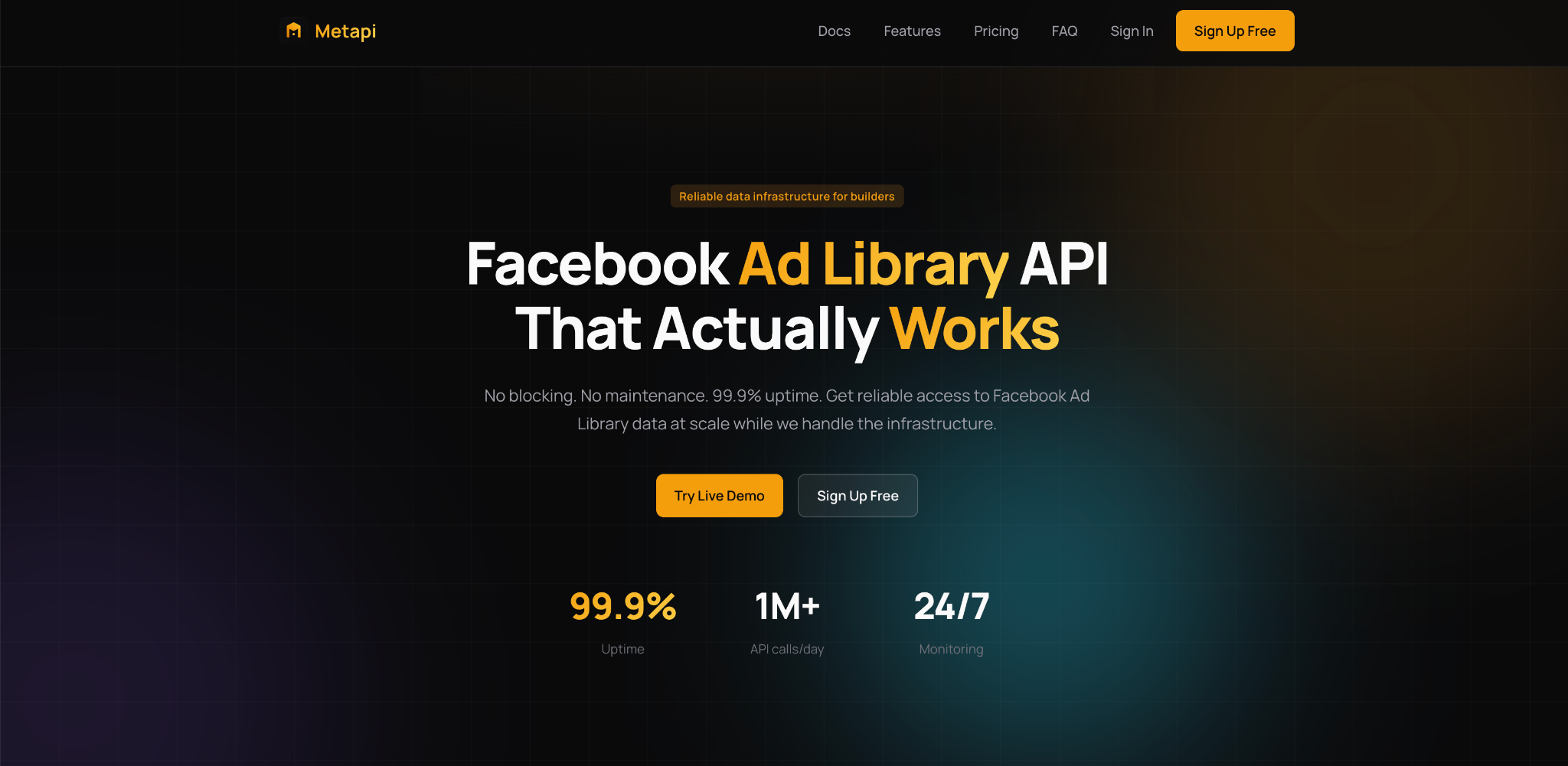
Metapi.io is a managed API for Facebook Ad Library data. Instead of writing and babysitting a scraper, you send a search request and get back clean, structured ad data. Metapi's team handles the infrastructure, blocking and every Meta front-end change on its side.
This matters more than it sounds. The Ad Library UI is a dynamic app that Meta updates without notice, so DIY scrapers and marketplace actors regularly break, return duplicates or stop at a few thousand results. Meta's official Ad Library API does not solve it either: it only covers political and issue ads and returns small pages of results. Metapi.io covers all ad categories, commercial ads included.
Full Ad Library search: filter by keyword, advertiser, country, active or inactive status, ad type, media type, platform and date, with relevance and date sorting.
Rich ad data: creatives (images, videos, carousels as media files, not just thumbnails), primary text, headline, description, CTA, landing page URL, advertiser page info, run dates, countries, languages and placements across Facebook, Instagram, Messenger and Audience Network.
Historical archive: 2+ years of ad data, including ads that are no longer visible in the public Ad Library.
Real-time webhooks: alerts on new ads by keyword, advertiser or category, with sub-second alert latency and delivery to Slack, email or your own endpoint.
Normalized output: typed, documented JSON and CSV exports that drop straight into a data pipeline.
Scale and uptime: 1M+ API calls per day, a 99.9% uptime SLA and 24/7 monitoring, with no IP bans or CAPTCHAs on your side.
Live demo: paste any Ad Library URL on the homepage and see real JSON results before signing up.
{
"q": "shopify",
"country": "US",
"count": 1000,
"active_status": "active",
"media_type": "all"
}
Every plan includes full API access, webhooks, exports and the historical archive. There are no feature gates, only volume limits.
Pros: zero scraper maintenance; covers commercial ads unlike Meta's official API; historical and removed ads; webhooks for automated competitor monitoring; predictable, volume-based pricing.
Cons: focused on Ad Library data, so for page posts, comments or groups you will need a second tool from this list. Like any Ad Library source, it cannot show exact spend or CTR for non-political ads, because Meta does not publish them.
Best for: SaaS builders adding ad intelligence to their product, agencies replacing the weekly manual check of competitor ads, media buyers and affiliates researching creatives, and researchers who need complete, historical Ad Library datasets.
Apify is a cloud platform with a marketplace of ready-made scrapers called actors. For Facebook there are official actors for pages, posts, groups and the Ad Library, plus dozens of community alternatives.
Key features:
Separate actors for pages, posts, comments, groups and ads
Scheduling, API access and integrations with Make, Zapier and webhooks
Built-in proxy pool on paid plans
Pricing: pay per result. Facebook ad actors range from roughly $0.20 to $3.40 per 1,000 ads depending on the actor, on top of the platform plan (Apify Store).
Watch out for: quality varies a lot between community actors. Users report duplicate results and runs that stop well below the number of ads shown in the Ad Library, and an actor can break for days after a Meta update.
Best for: teams that need several Facebook data types and are comfortable testing actors.
Bright Data is an enterprise web data platform that combines a huge proxy network with scraper APIs and pre-collected datasets, including Facebook pages, posts, comments and Marketplace data.
Key features:
Scraper APIs and ready-made datasets for Facebook
Residential, mobile and ISP proxies from the same vendor
Compliance and KYC processes aimed at large companies
Watch out for: pricing and onboarding are built for enterprise budgets, which is overkill for a small team.
Best for: large companies that want data and proxy infrastructure from one contract.
Octoparse is a no-code scraper with a point-and-click interface and templates for popular sites.
Key features:
Visual workflow builder, no programming
Cloud runs and scheduling on paid plans
Export to Excel, CSV, databases and APIs
Watch out for: Facebook's dynamic layouts and login walls mean templates need regular fixing, and large jobs get slow.
Best for: beginners and one-off extraction tasks.
PhantomBuster runs cloud automations ("Phantoms") that extract data from social platforms, including Facebook group members, post likers and commenters, and page data.
Key features:
Ready-made automations, no code
Runs on a schedule in the cloud
Chains extraction with outreach workflows
Watch out for: most Phantoms run through your own logged-in Facebook session cookie, so the account itself carries the risk. Pair it with an isolated profile and a stable proxy (see MoreLogin below).
Best for: growth and lead generation teams.
Scrapy is the standard open-source Python scraping framework. Paired with a headless browser such as Playwright or Puppeteer, it can handle Facebook's JavaScript-heavy pages.
Key features:
Full control over what you collect and how
Free and open source, large community
Scales well with your own infrastructure
Watch out for: you own all the maintenance: selectors, rate limits, CAPTCHAs, sessions and proxies. Running the browser part inside MoreLogin profiles solves the fingerprint and session layer.
Best for: developers building custom pipelines.
Meta's official APIs are the policy-compliant way to get data, but the scope is narrow. The Graph API returns data for assets you manage or that users authorize. The official Ad Library API covers mainly political and issue ads and requires identity verification and an approved app.
Watch out for: no access to commercial ads in the Ad Library API, strict rate limits and app review.
Best for: reporting on your own pages and ads, and political ad research.
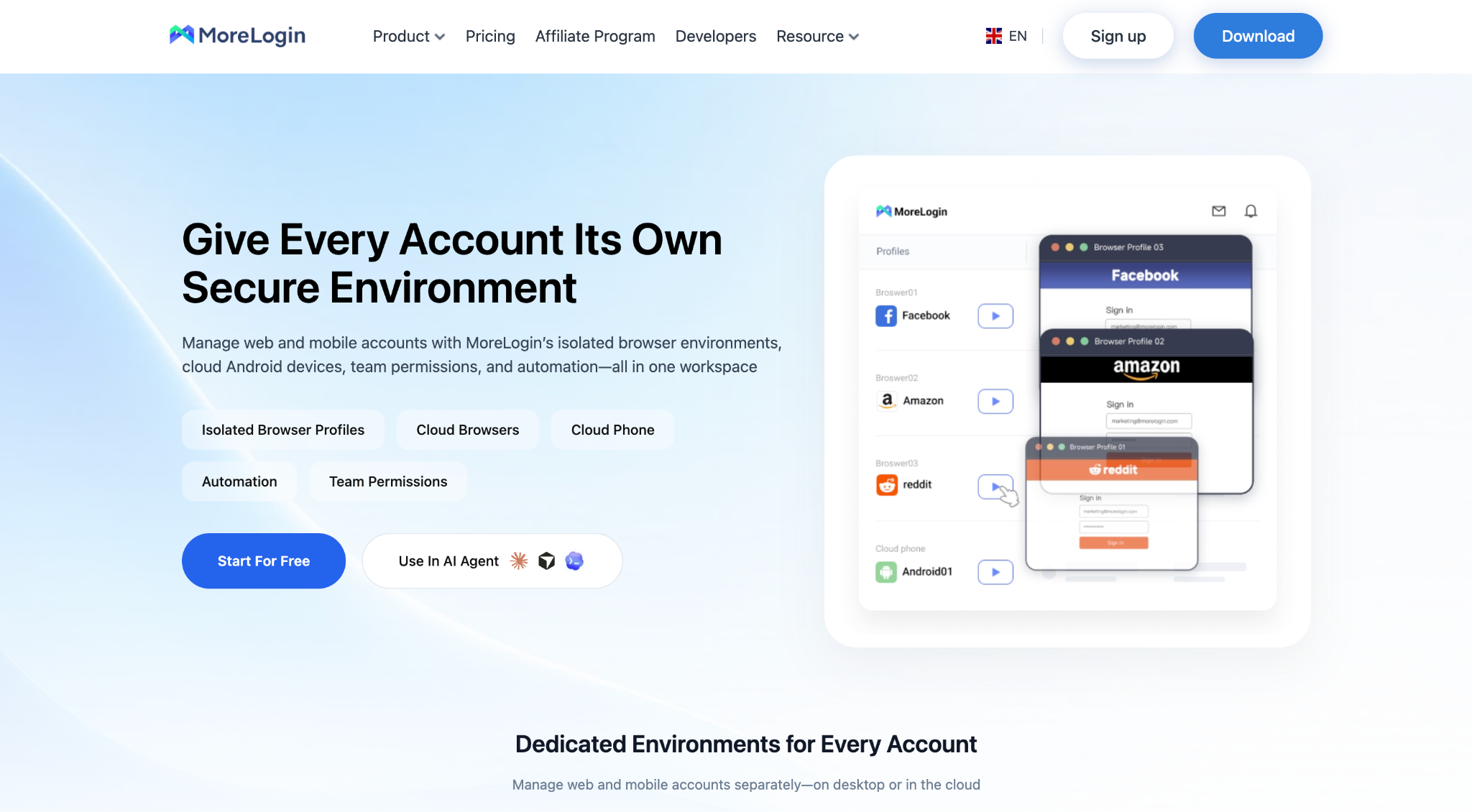
MoreLogin does not scrape Facebook itself. It is the layer that keeps the accounts, browsers and IPs behind your scraping and research workflows from being linked and flagged.
An API like Metapi.io takes care of Ad Library data without any accounts on your side. But many Facebook workflows still run through logged-in sessions: PhantomBuster automations, Selenium or Playwright scripts, manual research in groups and Marketplace, or managing the ad accounts you are benchmarking against competitors. If all of them share one browser fingerprint and one IP, a single flag can take down every account at once.
MoreLogin gives each account its own isolated browser profile with a unique fingerprint, cookies, storage and proxy, and its own Android cloud phone when the workflow has to run in the Facebook app.
Key features:
Isolated browser profiles with real canvas fingerprints, WebRTC control and Chromium and Firefox kernels
Per-profile proxies plus a built-in proxy resource center and batch proxy import
Cloud phones on Android 12 to 15 for app-based Facebook and Instagram workflows
Automation: Local API and WebDriver port access for Selenium, Puppeteer and Playwright, so your existing scripts run inside isolated profiles
Synchronizer to repeat actions across many profiles at once
Team features: permissions, operation logs, cloud sync of profiles and password protection
Pricing: the free plan includes 2 profiles forever, with no credit card. Pro starts at $5.40/month billed yearly ($9 monthly), with custom profile counts. Cloud phones are billed per minute at $0.006 and capped at $1.50/day (MoreLogin pricing). New accounts also get 100 free cloud phone minutes.
Best for: anyone running Facebook data collection, research or ad accounts across more than one profile.
A common 2026 stack: Metapi.io for all Ad Library intelligence, Apify or a Scrapy script for organic page and post data, and MoreLogin profiles for every logged-in session and ad account.
Meta's detection looks at IPs, device fingerprints, session history and behavior patterns. You cannot remove the risk, but you can remove the most obvious signals.
Use an API wherever you can. For Ad Library data, a managed API like Metapi.io means no Facebook accounts, no proxies and no fingerprints on your side at all.
One account, one profile, one IP. Give every logged-in account its own MoreLogin browser profile and a dedicated residential or mobile proxy. Never rotate IPs inside a single account.
Run automation in a real browser. Point Selenium, Puppeteer or Playwright at MoreLogin profiles through the Local API, so scripts inherit a consistent fingerprint, cookies and session instead of a clean headless browser.
Keep environments stable over time. An account that returns with the same device, location and cookies looks like a regular user. MoreLogin's cloud sync keeps profiles identical across team members.
Pace like a human. Add random delays, natural scrolling and breaks, and split large jobs into smaller batches.
Use cloud phones for app-only flows. If a task only works in the Facebook mobile app, run it on a MoreLogin cloud phone instead of an emulator on your own machine.
No tool can guarantee that Meta will never restrict an account. These steps reduce the patterns that make automated activity stand out.
It depends on what you collect, how and where. Meta's Terms of Service and Automated Data Collection Terms prohibit automated collection without permission. Personal data, even public, falls under privacy laws such as the GDPR in the EU.
The Ad Library is a special case: Meta built it as a public transparency tool that anyone can view without logging in, and it contains advertiser data rather than private user data. That is why ad intelligence is the lowest-risk Facebook data use case. For anything beyond a one-off project, especially personal data, get advice from a lawyer in your jurisdiction. This article is not legal advice.
Metapi.io It is a managed API that covers commercial and political ads, includes 2+ years of history and webhooks, and removes scraper maintenance entirely.
Yes, at small volumes. Metapi.io's free plan includes 3,000 ad records per month, Apify gives free monthly credits, Octoparse has a free tier, and Scrapy is open source.
It mainly covers political and issue ads, requires identity verification and app approval, and has strict rate limits. For commercial ads you need a third-party source.
Use an API where possible, give each logged-in account its own isolated MoreLogin profile and proxy, run automation in a real browser session and pace activity like a person.
Only for political and issue ads, where Meta publishes spend and impression ranges. For commercial ads, no tool can show exact spend, CTR or conversions, because Meta does not publish them.
No. MoreLogin provides isolated browser profiles and cloud phones so that scrapers, automation scripts and team members can work across many Facebook accounts without linking them.
Yes. MoreLogin's Local API lets you launch profiles and connect Selenium, Puppeteer or Playwright to them, so your scripts run with a consistent fingerprint and session.
The best Facebook scraping setup in 2026 separates two jobs: getting the data and protecting the accounts. For Ad Library intelligence, Metapi.io is the strongest choice: structured data, historical archive and real-time alerts with no scrapers to maintain. For organic content, Apify, Octoparse or a custom Scrapy pipeline fill the gaps.
Wherever your workflow touches logged-in Facebook accounts, run it inside MoreLogin. Each account gets its own fingerprint, proxy and session, so one flag never spreads to the rest.
 EN
EN