- Product

- Pricing
- Affiliate Program
- Developers
- Resource
 EN
EN
One of the most common questions in SEO is how many times you can use a keyword so that it helps rankings without turning into keyword stuffing. Is there a “safe” number for a 2,000-word article? Should you force the main keyword into every heading and paragraph even when the meaning is already clear?
The idea that a page can be properly optimized by repeating a keyword a specific number of times comes from outdated SEO practices. That’s when tools appeared that counted how often a word appeared in the text and called it keyword density.
In reality, search engines have never worked that mechanically. They don’t rely on these numbers the way SEO tools do. Such tools can only guess what might influence rankings, but they are not the real signals Google or other search engines use.
For search engines, what matters far more is how clearly the page topic is explained. Simply repeating the same word does not make content better or more useful. In practice, it usually does the opposite: it hurts readability and makes the text harder for users to consume.
Several years ago, Google began lowering the rankings of pages filled with low-quality text and excessive keywords. Today, search engines use much smarter technologies that understand meaning, not just individual words.
Google can easily understand what a page is about even if the exact keyword phrase isn’t repeated over and over. It looks at text structure, related terms, and overall logical flow. That’s why the old approach of “more keywords equals higher rankings” no longer works.
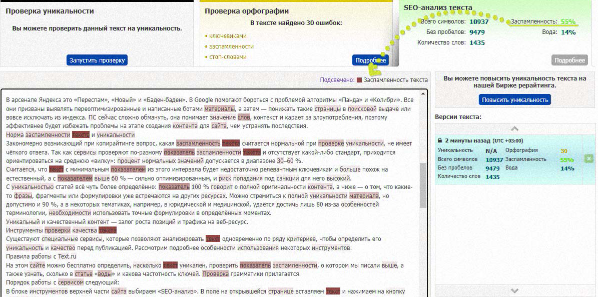
This doesn’t mean keywords are no longer important. They still help search engines understand a page’s topic. Keywords are used in headings, body text, internal links, page titles, URLs, and structured data.
Problems begin when keywords are added without context, just “for SEO.” If a phrase sounds unnatural or has to be forced into a sentence or heading, that’s a clear sign something is wrong.
Keyword stuffing is not about hitting a specific number or percentage. It starts when keywords are inserted without real justification—into sentences, headings, or links purely for ranking purposes.
As a result, content quality drops. Text becomes heavy, headings look awkward, and the material is harder to read. A better approach is to use different words and phrases with the same meaning. Modern search engines clearly understand that “swimwear” and “beach clothing” refer to the same topic.
In practice, the most effective approach is simple: if your main keyword is already in the H1, there is no need to repeat it intentionally in every H2 or H3.
Headings should follow logical structure. The main heading defines the topic, while subheadings expand on individual aspects. For example, if the H1 is “Blue T-Shirt” and the H2 is “T-Shirt,” both users and search engines still understand that the page is about a blue T-shirt.
But when every heading repeats “blue T-shirt,” it starts to feel intrusive and harms readability. Another clear sign of outdated SEO is overloaded footers filled with repetitive keyword-rich links—this approach no longer works.
To work with keywords correctly and avoid spam, these tools are useful:
Wordstat or KeyCollector – keyword research
Topvisor or Pixel Tools – performance and ranking tracking
Arsenkin Tools – heading analysis, rank checks, and semantic clustering
MoreLogin– a browser for safely managing multiple accounts and projects without ban risks
Headofseo – meta tag generation based on keyword phrases
There’s no need to obsess over keyword counts. Focus on writing clear, useful content for real people, logically covering the topic, and placing keywords only where they make sense. If a text reads naturally and is easy to understand, search

 EN
EN